NORM Decontamination for Oil & Gas New Standard
The End of the Sacrificial Asset: How Closed-Loop Chemistry Is Rewriting NORM Decontamination
For half a century, the oil and gas industry has treated radioactively contaminated equipment as something to be destroyed rather than restored. A closed-loop chemical process developed by Radion Core challenges that assumption at its foundation — and in doing so, reframes what "clean" means for an industrial asset.
The problem nobody solved because everybody split it apart
Walk into any refinery turnaround, any offshore decommissioning yard, any tubular storage bank in the Gulf, and you will find the same object: a length of steel whose internal surface has become a geological record of everything that ever flowed through it.
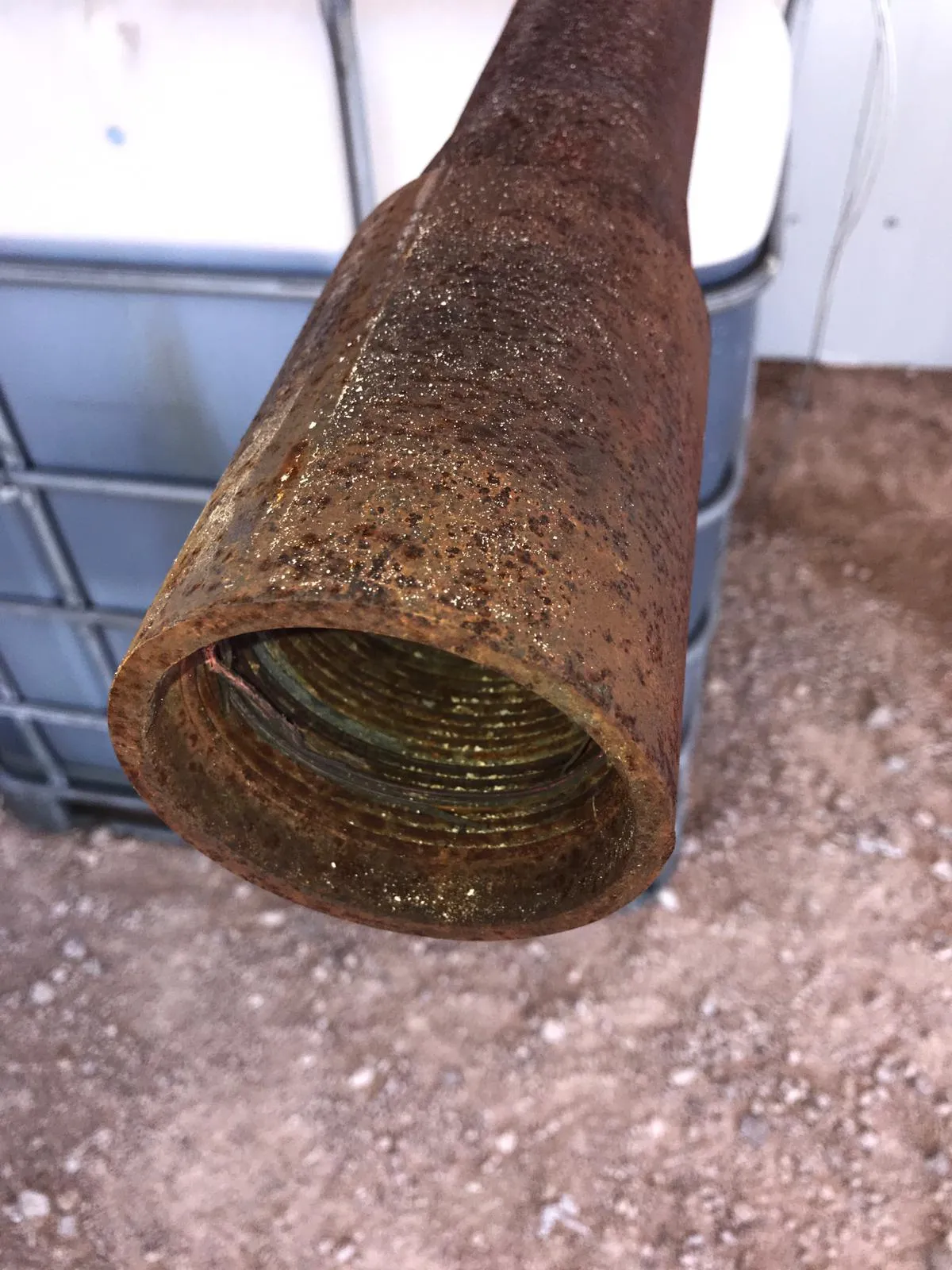
Cut it open and the stratigraphy is unmistakable. Against the parent metal sits a layer of inorganic scale — iron oxides, calcium carbonate, calcium sulphate and the corrosion products of decades of service. Bonded into and over it are heavy organics: crude residues, asphaltenes, bitumen-like deposits, coke and sludge. Interleaved through both are paraffins and waxes, adhesive and hydrophobic, sealing the deposit against water-based attack. And distributed invisibly within the scale matrix, co-precipitated with it over the operating life of the asset, are the radionuclides: radium-226 and radium-228, lead-210, potassium-40, thorium isotopes, and — in certain crude streams where specific geological conditions allow uranium to dissolve directly into the oil — trace uranium.
This is not four problems. It is one problem wearing four disguises.
The industry's response has historically been to treat it as four. Mechanical descaling for the inorganics. Solvent washing for the hydrocarbons. Thermal or steam treatment for the waxes. And for the radioactivity — the contaminant that cannot be dissolved away, only relocated — a regulatory decision that has quietly cost the sector billions: classify the asset as waste, wrap it, drum it, ship it, bury it.
The reason this sequential approach fails is structural rather than chemical. Each contaminant layer protects the ones beneath it. Paraffins shield scale from aqueous chemistry. Scale physically encapsulates radionuclides, placing them beyond the reach of any surface treatment. Water jetting, the industry workhorse, delivers kinetic energy in a straight line — and a straight line is precisely what the internal geometry of a shell-and-tube heat exchanger does not offer. Mechanical methods that do reach the deposit generate exactly what the operator was trying to avoid: filings, shavings, grit and spent slurry, all now bearing the radioactivity of the original scale, all now requiring characterisation and disposal at a volume often exceeding that of the contamination itself.
The cruellest arithmetic in NORM management is this: conventional cleaning frequently produces more radioactive waste than it removes.
A different premise
The REVO-CLEAN™ process begins from an inversion of the conventional logic. Rather than asking which method removes which contaminant, it asks a single question: can a chemistry be formulated that attacks the entire contamination profile simultaneously, in situ, without consuming the parent metal?
The process operates as a closed loop across five stages.
Fill and circulate. The asset — tubular, pipe spool, heat exchanger, vessel — is filled or has the proprietary solution circulated through it. No disassembly beyond normal isolation. No line-of-sight requirement. The chemistry goes wherever the process fluid once went, which is by definition wherever the contamination is.
Penetrate. This is the stage that distinguishes the process from conventional chemical cleaning. The formulation is designed to work through the composite deposit rather than merely at its surface — advancing through paraffin, hydrocarbon and scale phases in a single continuous action, reaching the radionuclides held within the scale matrix rather than stopping at the layer above them.
Separate. Deposits detach and transfer into the circulating liquid phase. Critically, the radioactivity migrates with them. The contamination is not being redistributed across the asset surface or driven deeper into pitting; it is being lifted off the metal and carried into a stream the operator controls.
Recover. Centrifugation separates the mobilised solids from the liquid, concentrating the contamination into a small, controlled residue stream. This is the step where volume reduction happens — where a fouled thirty-foot tubular becomes clean steel plus a few kilograms of characterised solid.
Regenerate. The solution is recovered and returned to the loop. It is not consumed, neutralised and disposed of at the end of each cycle. It works again.
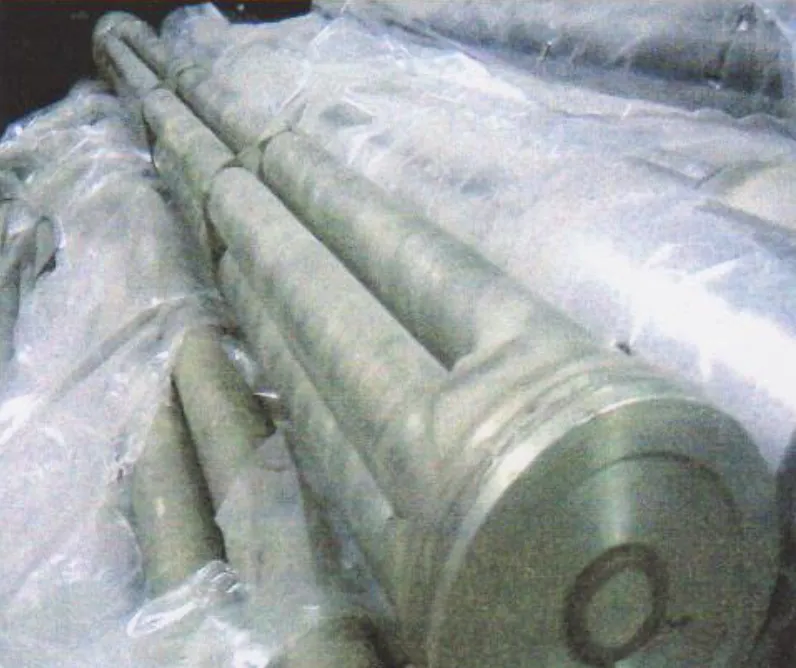
The outcome the process is engineered toward has a specific name: homogeneously clean metal. Not visually clean. Not clean at the accessible surfaces. Uniformly clean throughout the treated geometry, with the parent material — including protective coatings — intact and unattacked. Field imagery from tubular treatment shows internal bores restored from heavy corrosion and scale to bare, uniform steel showing the original machining and thread profile.
Why regeneration is the actual breakthrough
It is tempting to locate the innovation in the chemistry alone. That would be a misreading.
The transformative element is that the loop closes. In a conventional chemical clean, solvent is a consumable: it is pumped in, it is spent, and it emerges as a liquid radioactive waste stream — the single most expensive and most heavily regulated waste form in the entire remediation hierarchy. Liquid radioactive waste must be characterised, stabilised, often solidified, transported under specialised licence and consigned to a disposal route with finite national capacity. Its cost frequently exceeds the value of the asset being cleaned, which is the economic reason so many operators simply choose disposal from the outset.
By regenerating and reusing the working solution, the process eliminates that stream. Contamination leaves the system as concentrated solids, not as bulk contaminated liquid. Three consequences follow, and they compound:
Minimal secondary waste. The disposal volume is a fraction of that produced by mechanical or single-pass chemical methods, because the contamination is concentrated rather than diluted into a carrier medium.
Lower disposal cost. Less material to characterise, transport and consign — a reduction that appears directly on the project's commercial ledger rather than in a sustainability appendix.
No continual chemical consumption. The reagent is a capital input to the loop, not a running cost that scales with the length of the job.
This is the point at which decontamination stops being a cost of disposal and starts being an alternative to it. When the residual waste volume is small enough and the chemical consumption low enough, restoring an asset becomes cheaper than destroying it. That inversion — not any single reaction — is the discovery.
The clock that never stops
There is a second, quieter advantage that operators tend to notice on the first project.
Water jetting is labour. It proceeds while operators are on the tools and stops when they leave. In practice this yields eight to twelve productive hours in any twenty-four, and the remaining twelve to sixteen are dead time in which an asset sits fouled and a turnaround critical path lengthens.
A circulating chemical process has no such dependency. The reaction requires no operator presence. Equipment is routinely left circulating overnight; the chemistry continues dissolving contamination through the hours when a jetting crew would be off shift. Effective cleaning time approaches twenty-four hours per day.
For heat exchangers the difference becomes categorical rather than incremental. Shell-and-tube exchangers are among the hardest refinery assets to clean: small-bore tubes and deep internal surfaces resist line-of-sight methods entirely, and mechanical cleaning proceeds tube by tube in a sequential, labour-intensive programme that still leaves adhesive deposits in inaccessible regions. Circulating chemistry acts throughout the entire exchanger at once. Hundreds of parallel tubes are treated simultaneously, including internal surfaces no lance will ever reach. Before-and-after field results on fouled bundles show tubes fully blocked by scale, hydrocarbon and NORM-bearing deposits returned to bare, homogeneously clean metal — in place, without the bundle being sacrificed.
Precedent in the most demanding environment there is
Oilfield NORM is a serious contamination problem. It is not, however, the most severe test of a decontamination chemistry.
That distinction belongs to equipment that has been in direct contact with spent nuclear fuel — where contamination comprises not naturally occurring radium and lead but fission products such as caesium-137 and strontium-90, neutron-activation products including cobalt-60, europium-152 and europium-154, and highly active microparticles of fuel-cladding material and of the fuel itself.
The technology lineage behind REVO-CLEAN™ has been validated in exactly that environment. In an industrial trial programme conducted at a state atomic energy facility, twenty stainless-steel fuel-handling casks carrying initial surface contamination from 70 to 8,000 Bq/cm² were processed to 0.5–5 Bq/cm² — free-release values permitting unrestricted reuse of the metal in subsequent recycling. Processing time was 60 to 90 minutes per unit. The parent metal showed neither corrosion nor mechanical damage. Removed activity was concentrated onto small-volume mechanical and sorption filters, and the closed cycle produced no liquid radioactive waste. Items that had been categorised as radioactive waste were returned to the metals stream.
Signed and apostilled confirmation of that programme, issued directly by the atomic association concerned, is available on request.
The relevance to oil and gas is direct. A chemistry that can lift activated cobalt and europium out of the surface of a spent-fuel cask is operating several orders of magnitude above the difficulty of removing radium co-precipitated in barium sulphate scale.
From claim to engineering
A process of this kind lives or dies on whether its performance can be predicted before mobilisation rather than discovered during it. Contamination profiles are site-specific; scale mineralogy, hydrocarbon character and radionuclide loading vary between fields, between wells, and between assets in the same train.
Radion Core's answer is a twelve-stage feasibility study executed as the first engineering phase of every project rather than as a preliminary report: site inspection, asset survey, sample collection, laboratory analysis, contaminant identification, process testing, waste-route assessment, equipment configuration, time and resource planning, commercial modelling, risk controls, and a guaranteed technical solution.
The distinction matters. The output is not a recommendation for the operator to act upon; it is a complete technical solution with defined equipment, defined timing, a defined waste route and a defined commercial basis. Responsibility runs from assessment and process design through mobilisation, cleaning, separation and final verification.
What changes if this holds
The implications extend well beyond a cleaner pipe.
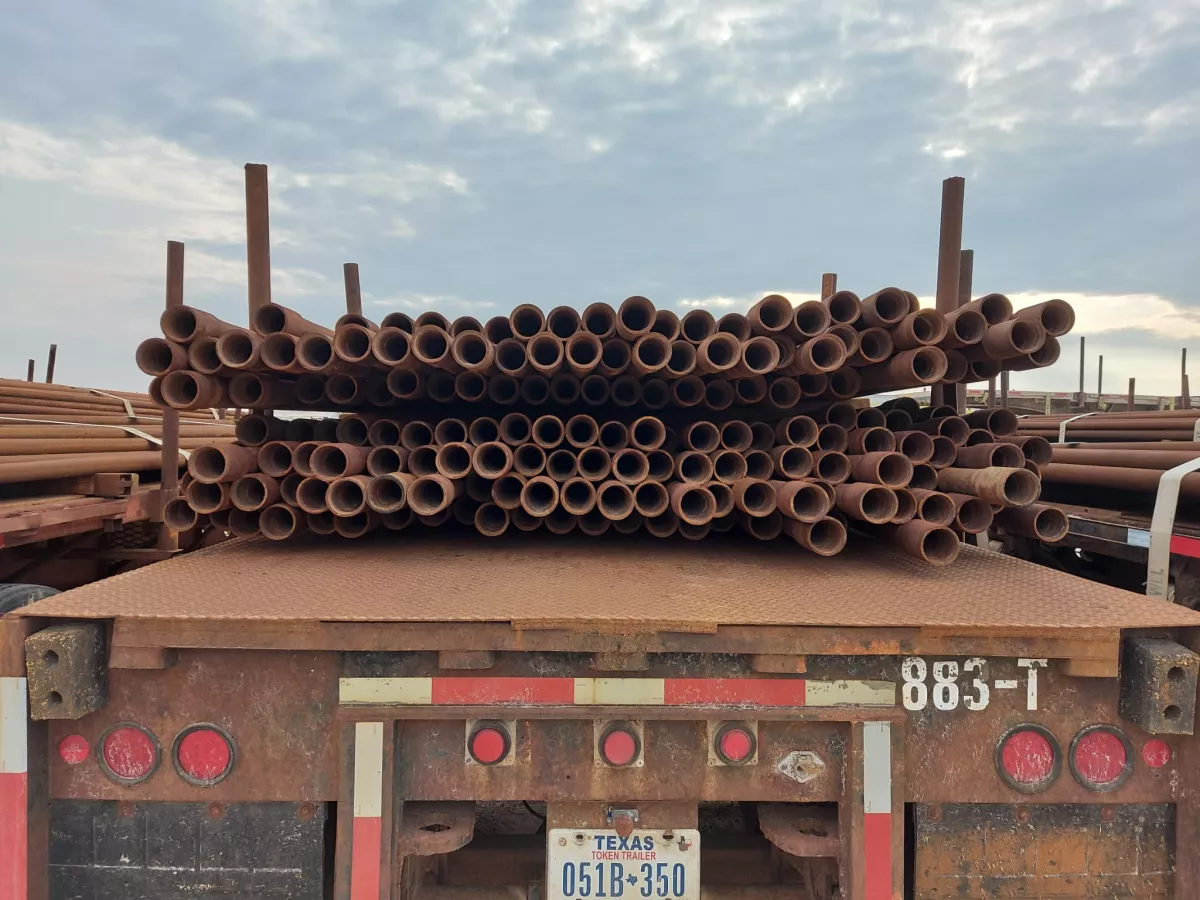
The prevailing model of NORM management is fundamentally custodial: contaminated steel is a liability to be contained, tracked and eventually interred, and every year of storage adds cost without adding value. Contaminated tubulars occupy yard space on five continents. Decommissioning programmes carry disposal line items that dominate their budgets. Operators in jurisdictions with limited licensed disposal capacity face a constraint that no amount of capital can simply purchase away.
A process that returns contaminated steel to homogeneously clean metal — verifiably, economically, and without generating a liquid radioactive waste stream in the attempt — converts that liability into inventory. The asset re-enters service or re-enters the metals market. The disposal line item shrinks to the small solid residue that genuinely requires it. The scarce national disposal capacity is consumed by the contamination rather than by the steel that happened to be carrying it.
The technology is deployed, with field projects executed in Qatar and Kuwait, and mobile closed-loop systems engineered for continuous internal pipe cleaning already operating in the field.
The question the sector now faces is not whether contaminated assets can be restored. It is how many of them were buried while everyone assumed they could not be.